
Running a Sex Offender Check in Isle of Wight County
The official starting point is the free Virginia Sex Offender and Crimes Against Minors Registry. Virginia State Police maintains that system under Virginia Code § 19.2-390.1. It supports both individual and geographic searches, so an Isle of Wight County resident can begin with a known name or scan a county, town, ZIP code, or address area when the live interface offers that control. Search terms should be kept broad at first. A misspelled first name or an old town label may hide an otherwise relevant result.
The registry is one part of a complete Isle of Wight County check. The National Sex Offender Public Website adds participating jurisdictions beyond Virginia. The Isle of Wight County Sheriff's Office can explain local registration logistics in unincorporated areas, and Smithfield or Windsor police can route a town-based report. Virginia State Police's registry unit handles state administration. These channels answer different questions, so a web result should be read with its displayed update and compliance status rather than treated as a permanent fact.
Isle of Wight Registry Routes
Isle of Wight County has two incorporated towns, Smithfield and Windsor, plus a large unincorporated area. That geography matters when someone needs more than a web search. For local registration-office details outside the towns, call the Isle of Wight County Sheriff's Office at (757) 357-2151 before visiting 17110 Monument Circle, Isle of Wight, VA 23397. Published appointment and registration hours were not located, so a call prevents a wasted trip. The Smithfield Police Department and Windsor town government can route issues arising within their own boundaries.
Questions about the statewide file belong with the Virginia State Police Sex Offender Registry unit at (804) 674-2825 or sor@vsp.virginia.gov. Suspected noncompliance should go to the law-enforcement agency for the place involved or to that state unit. Give facts, not conclusions: identify the public profile, the date it was checked, and the item that seems stale. An emergency still goes to 911. Do not post allegations on social media or attempt to verify an address in person.
The official Virginia law page shows the state framework behind registry maintenance. Review Virginia Code § 19.2-390.1 before relying on a summary.
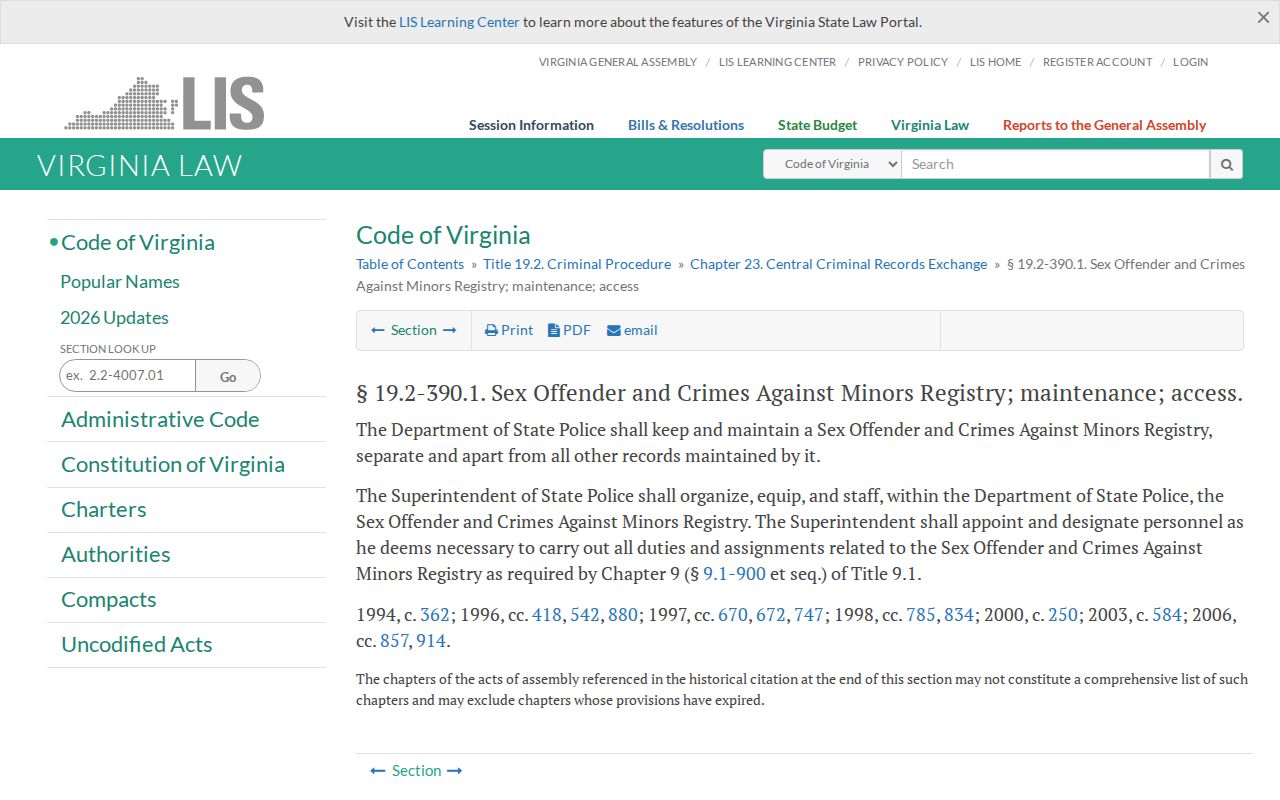
The statute image connects Isle of Wight County registration records to the Virginia State Police system that maintains and disseminates the public registry.
Searching the Virginia Sex Offender and Crimes Against Minors Registry
Use the official registry search conditions as written. The interface can change, and its crawlable layer did not expose exact radius choices during research. No distance option should be guessed. If a radius search misses a road near a town or county boundary, repeat the search by ZIP, county, street address, and name. Smithfield and Windsor are useful location terms, but neither represents all of Isle of Wight County.
- Open the Virginia registry and read its conditions and misuse warning before accepting them.
- Choose a name search for a known person or a geographic search for an Isle of Wight County area.
- Review the result list, checking the name, photograph, locality, and status without copying a private profile elsewhere.
- Open the official profile and note the displayed update, verification, offense, and registering-agency fields.
The available controls support several ways to narrow an Isle of Wight County registry check. Exact and partial-name behavior should be tested on the live portal.
| Field Label | Type | Required | Notes |
|---|---|---|---|
| Search by Name | Mode | Choice | Use for an individual lookup |
| Last Name | Text | Principal name field | Confirm live matching behavior |
| First Name | Text | Optional | Narrows an individual lookup |
| County, City, or ZIP | Select or text | Geographic mode | Try Isle of Wight, Smithfield, Windsor, or a supported ZIP |
| Street Address | Text | Address mode | Supports proximity searching when enabled |
| Radius | Select | Conditional | Use only the choices shown in the live portal |
| Map or List | Display control | No | Changes the geographic result view when enabled |
Isle of Wight Registry Comparison
The Virginia registry is the primary source for a record maintained by Virginia State Police. NSOPW is the broader layer. It searches public registry data from participating states, territories, and tribes, which can help when a person recently crossed a state line or when Isle of Wight County is only one part of the relevant area. NSOPW may route the reader back to the source jurisdiction for the full details.
Neither tool replaces the other. Start with Virginia for a focused Isle of Wight County sex offender search. Then use NSOPW for cross-state context. If the two displays seem inconsistent, compare their update dates and return to the source registry or state unit. Search results can change as addresses, status, and verification records are updated.
The official NSOPW search provides the national query layer without routing through a commercial data aggregator.
This national search is most useful after a Virginia query when an Isle of Wight County safety check may need to account for nearby or former out-of-state locations.
What a Registry Profile Shows
A public Virginia profile is an official registry snapshot, not a private dossier. It may identify the registered name and aliases, show a current photograph and physical descriptors, and display the registered residence or locality according to portal policy. It can also state the qualifying offense, jurisdiction, conviction date, registration classification, verification indicators, and the agency tied to the entry. Some profiles may show scars, marks, tattoos, vehicles, school, or work attributes when current law makes those fields public.
Private registrant details should not be copied or republished. Read the profile in place. The last verification or update field is essential because an address can change. A listing also does not tell the full story of every court event. The current case docket and final order belong to the court system, while the registry answers the narrower statutory registration question.
| Name and Aliases | Registration identity and other names displayed under portal policy |
|---|---|
| Photo and Description | Current image and permitted physical identifiers |
| Registered Location | Residence, locality, and ZIP presentation allowed by law |
| Offense Details | Qualifying offense, statute or jurisdiction, and conviction information |
| Classification | Virginia registration category rather than an invented federal tier |
| Status and Update | Compliance, verification, update date, and registering-agency indicators |
Note: A public registry profile and a current Virginia criminal court docket are separate official records with different purposes and update cycles.
Isle of Wight Registration Packets
Virginia's registration process uses concrete forms and identity materials. Under 19VAC30-170-15, initial registration uses form SP-236, a clear ten-print fingerprint card, a clear palm-print card, and a photograph. Reregistration uses SP-236A with clear prints of both thumbs. If a thumb is absent, the index finger may be substituted and noted. A change of address uses SP-236 plus another clear ten-print fingerprint card.
The photograph must be in color, show the face and shoulders from the front, and contain no other person. The full name, date of birth, and photograph date go on the back. The completed materials route to VSP CCRE, Attn: Sex Offender Registry, P.O. Box 27472, Richmond, VA 23261-7472. Forms may come from Virginia State Police, a sheriff, local police, or by mail. Isle of Wight County residents should call the correct local office before appearing because the county sheriff did not publish specific registration appointment hours.
The official Virginia Administrative Code rule lists the registration and reregistration materials.
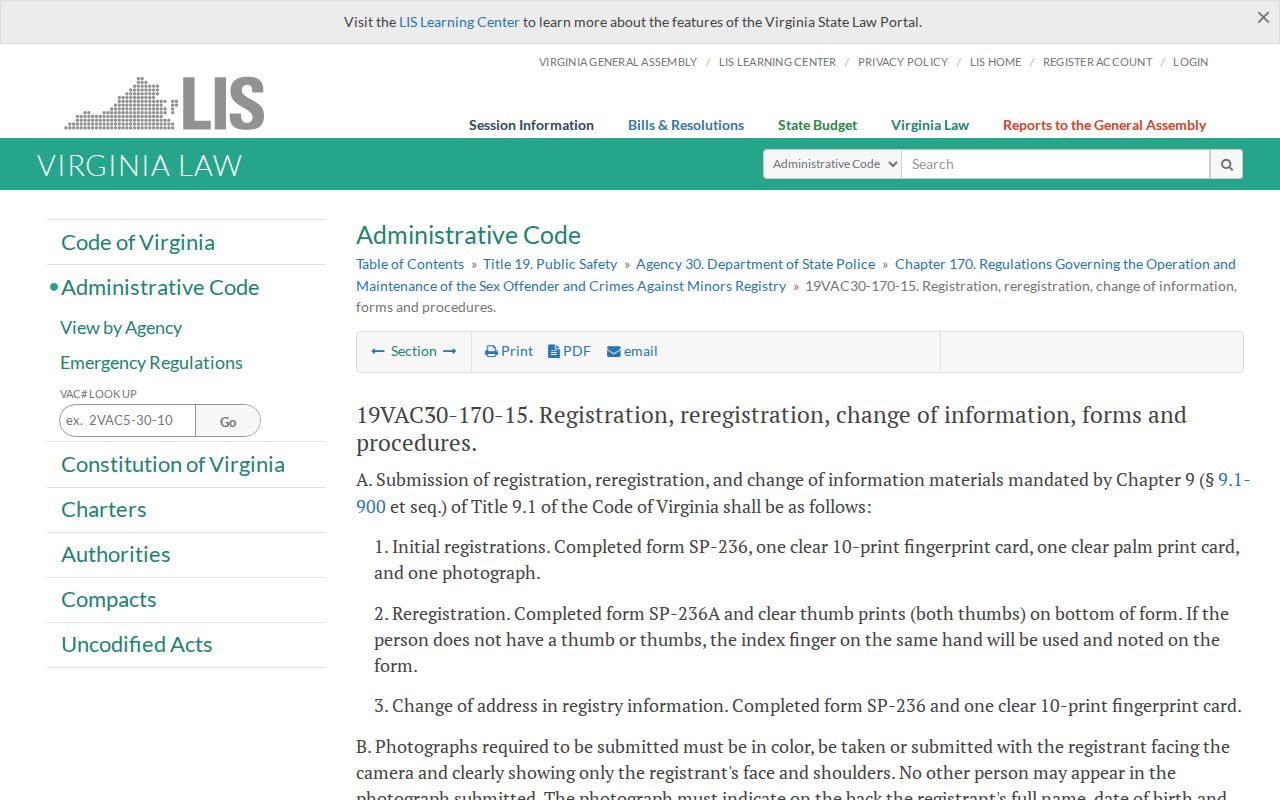
The rule shows why an Isle of Wight County registration visit is more than a name entry: forms, photographs, and specific fingerprint records support the state file.
Registration Requirements and Levels in Virginia
Virginia does not place every registrant into a simple federal Tier I, II, or III chart. State law distinguishes standard registrable offenses, sexually violent offenses, repeat convictions, and other categories with their own statutory triggers. The duration and verification duty must be tied to the current offense-specific law. Broad claims that every person registers for one fixed ten-year, twenty-five-year, or lifetime term are unreliable.
Virginia generally imposes lifetime duties for sexually violent, repeat, and other enumerated categories. Some people in nonviolent categories may petition for removal after the statutory minimum when every condition is met. A petition opportunity is not automatic removal. Current §§ 9.1-908 through 9.1-910 control, and the public profile's Virginia classification should be read as displayed.
| Virginia Category | Duration | Visibility and Verification |
|---|---|---|
| Standard registrable offense | Controlled by the offense statute and petition rules | Registration and reregistration follow the applicable Virginia provisions |
| Sexually violent offense or covered murder | Generally lifetime under the Virginia scheme | Heightened duties and more frequent verification may apply |
| Repeat or statutory lifetime category | Lifetime under current enumerated provisions | Public status and verification follow the statute |
| Juvenile or special category | Depends on the statutory trigger and court treatment | Visibility and duration require category-specific review |
Isle of Wight ZIP Notifications
Virginia State Police form SP-285 provides a formal request for notice of registration or reregistration in the same ZIP code or a contiguous ZIP code. That is a different task from repeatedly running a name search. The form-based channel can support ongoing Isle of Wight County community awareness, while the live portal should be checked for any current electronic notification option.
A ZIP alert still has limits. Postal boundaries do not always match Smithfield, Windsor, or the Isle of Wight County line. A person near a boundary should combine the notification request with periodic county, town, ZIP, and address-area searches. If the radius tool appears to omit a nearby road, vary the location input instead of guessing that no record exists.
Lawful Use and Community Notification
Registry information exists for public protection and sound safety planning. Virginia Code § 9.1-912 governs public access and official dissemination. The best use is calm and factual: read the profile date, use official notification tools, discuss age-appropriate safety steps with family members, and report a specific compliance concern to law enforcement. A registry result does not authorize trespass, surveillance, threats, or direct confrontation.
The official registry access statute is the primary source for how Virginia makes this information available.
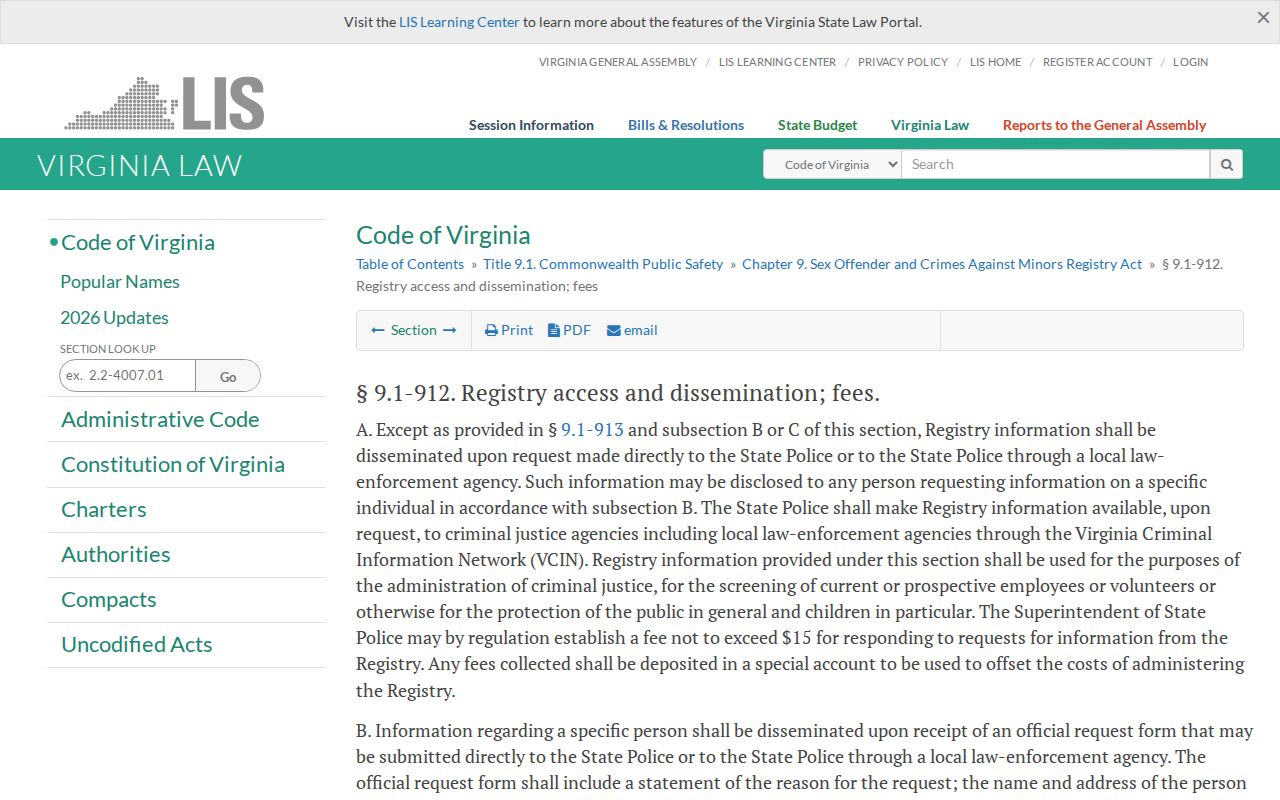
The statute grounds Isle of Wight County community access in Virginia law and reinforces why public availability carries legal limits.
Registry Misuse Is a Crime: Virginia Code §§ 9.1-912 and 9.1-914 do not permit harassment, intimidation, threats, or criminal acts against a registrant or household. Report concerns to law enforcement and do not confront anyone.
Report Isle of Wight Registry Issues
When a registered address or status looks outdated, first capture the public profile's update date and registering agency. Then contact the Isle of Wight County Sheriff's Office for a location in the unincorporated county, or the relevant town police department for Smithfield or Windsor. The Virginia State Police SOR unit is the fallback for registry administration. Provide the observed facts and let trained staff assess compliance.
Do not assume a mismatch proves a crime. Update timing, a recent move, a boundary label, or a portal display issue can explain differences. The safe path is to compare official searches, preserve the date checked, and report through an official channel. That process protects the community without exposing a listed person, family member, or neighbor to an unsupported public accusation.